
A Pakistani-Canadian family recently fell victim to another hate crime against Muslims in Canada. Here is a list of some historic attacks against the country’s largely peaceful Muslim community.
Five members of a Muslim family became the latest target of anti-Islam attacks in Canada. The hate crime claimed the lives of four family members and critically wounded a child.
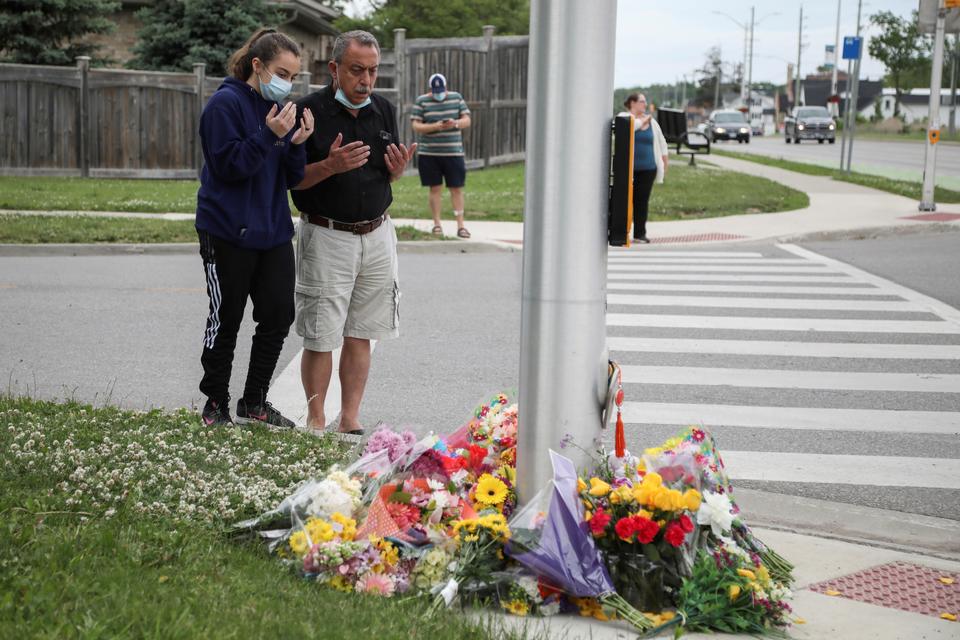
The 20-year-old Canadian attacker, Nathaniel Veltman, ran over the family with his pick-up truck in London, Ontario on Monday.
Canadian authorities defined the incident as a “horrific act of Islamophobia.”
While Canada presents itself as one of the most liberal states under its Prime Minister Justin Trudeau, anti-Islam hate crimes continue to be a threat to both communal peace and Muslim lives in the North American country.
Canadian legal authorities, like most Western countries, do not define anti-Islam attacks as terrorist acts despite calling incidents by radical armed groups like Daesh and Al Qaeda terror acts.
Here is a short list of some past anti-Islam attacks in Canada:
Quebec City mosque attack
In late January 2017, Alexandre Bissonnette, a 27-year-old university student and a former Royal Canadian Army Cadet, attacked the Islamic Cultural Centre of Quebec City, killing six worshippers and wounding five others.
Bissonnette held similar views to New Zealand’s Christchurch mosque shooter, Brenton Tarrant, an Australian citizen, having far-right and white supremacist political views. The Canadian attacker was also a fan of former President Trump and French far-right leader Marine Le Pen.
The attacker was sentenced to life in prison. While Canadian leaders like Trudeau called the assault an act of terror, Bissonnette was not charged under the terrorism clause of the country’s Criminal Code.
The Quebec City attack has led to widespread public debate in Canada about why Islamophobic attacks motivated by right-wing political views have been on the rise across the country.
In 2017, hate crimes climbed significantly in Canada to the previous year. But with a 207 percent increase in hate crimes against Muslims, anti-Islam attacks were much higher than attacks against other social groups.
Even after the Quebec City Mosque shooting, which was widely condemned by the country’s leaders, attacks against Muslims “peaked”, according to an Islamophobia report.
Attacks on other mosques
Canada’s Islamic worshipping centres have been the target of anti-Islam attacks during the last decade. Mosques have been constantly threatened by hate groups since 2013.
In 2015, the only mosque in Ontario’s Peterborough was set on fire by a hate group. A year before that vandalisation, another anti-Islam assault, which was prevented by the police, targeted a Montreal mosque. In 2014, the Montreal police found a suspicious package in front of another mosque. The package was neutralised by the police.
Attacks on hijabi women
In Canada, many Muslim women have been long targeted by hate groups. Some of those attacks have apparently increased after Quebec, the country’s French-speaking second largest province by population, considered a bill which proposed a ban on wearing religious symbols including hijab in public spaces in 2013. The bill failed to become law.
In 2013, a number of Muslim hijabi women were assaulted across Quebec as attackers forcibly removed their headscarves. Since then, hijabi women including one pregnant woman have been targeted by racist attackers.
Despite continuing attacks, in 2019, Quebec premier François Legault claimed that there was “no Islamophobia in Quebec.” After a political backlash, he backtracked from his comment.
Canadian media
Canadian media has fuelled anti-Muslim sentiment, making the country’s Islamophobia-related issues worse, according to experts.
“Islamophobia is a direct result of the anti-Muslim rhetoric conveyed in the media”, said a 2019 statement by Canadian Muslim Alliance, referring to the country’s press organisations.
“We appeal to the Canadian, Quebec and municipal governments to stand against this type of hate speech. Words matter,” the statement added.
Comments
Post a Comment